
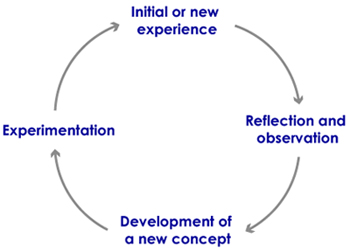
Action – Reflection – Action is a reflection model used in education and leadership. This model describes the process of learning, starting with taking an action. The process is cyclical because as action leads to reflection, a new action develops, and the process repeats.
While Elaine Graham and the National Association of Catholic Chaplains expand on the single step of reflection, and develop criteria for questions and sources to include in reflection, the action-reflection model shows the entire scope of the learning process. See this diagram from the Monash University’s Language and Learning Center, showing the continuous cycle of action and reflection.
Action and Contemplation is also a significant part of the Christian mystical tradition. There has long been a tension between works and acts and prayer and reflection. Richard Rohr’s Center for Action and Contemplation is a modern center for exploring the Christian tradition of contemplation. While contemplation unites lived experiences with stories of faith, it does not necessarily link them within culture and context. Read Richard Rohr’s definition here. Of course, culture and context infiltrate contemplation even if it is not a conscious choice. Therefore, perhaps it would be helpful to openly acknowledge the ways culture and circumstances impact contemplation. This is an example of an implicit curriculum. While culture and context are obviously embedded in the practices of contemplation, they are not named outright.
Joe Holland and Peter Henriot, S.J. advocate for taking stock of culture in their book Social Analysis: Linking Faith and Justice. They advocate for an extra step called social analysis and call their model the Pastoral Circle. It comprises an “insertion” experience, social analysis, theological reflection, pastoral planning. The following diagram comes from the blog Locus Theologicus (this post also contains an interesting discussion of Karl Rahner’s ideas about practical theology).
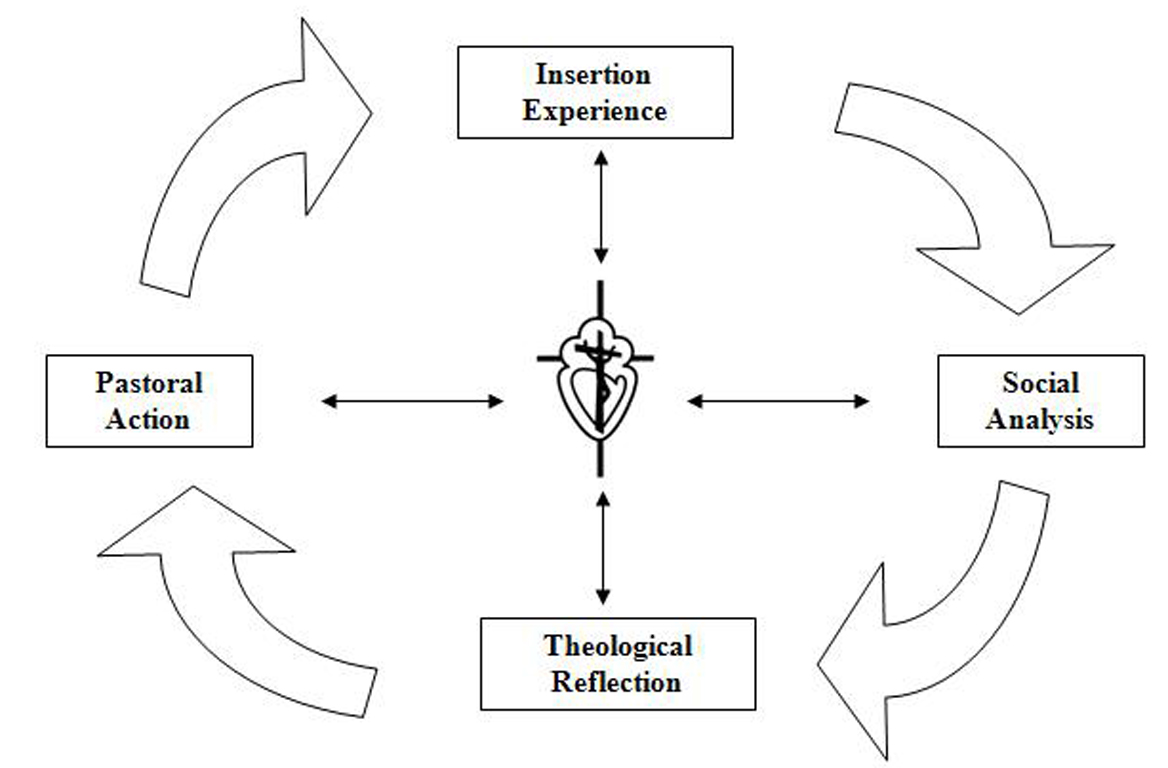
Holland and Henriot’s pastoral circle
Holland and Henriot list the following as factors in social analysis: historical dimensions, structural dimensions, divisions of society, and levels of reality. See a summary of the Pastoral Circle here.
In Holland and Henriot’s work, I found three questions very helpful in adding social analysis to any circle of reflection. It could easily be added to contemplation as well as the action-reflection model. In considering divisions in society, they suggest asking these three questions:
Who makes the decisions?
Who benefits from the decisions?
Who bears the cost of the decisions?
In considering these factors, Holland and Henriot unite tradition, culture, and personal experience in a meaningful process of theological reflection.
 Katherine Kunz, Ph.D.