
Reflective Believing

After all of this writing on Theological Reflection, I introduce a new concept, Reflective Believing. This concept is developed in an unpublished paper, by Edward Foley, Capuchin. His paper critiques the usefulness of theological reflection in a pluralistic age. Theological Reflection was, after all, developed for Christian seminary students. Foley realized the simply re-purposing theological reflection for other faith communities did not do justice to the experience of these communities. In addition, how can Christian ministers relate to the diversity of faiths as well as the ever-increasing number of people who remain unaffiliated with religious organizations?

The statistics of decreased religious affiliation in the US are not news to many of us. In fact, my case studies are all drawn from friends who do not hold fixed religious affiliations.

Foley gives 22 “rules” for what he calls the “language game” of Reflective Believing. At the end Foley summarizes these rules with the following paragraph:
“In light of this grammatical sketch, it is possible to define reflective believing as a meaning making practice, exercised in light of one’s individual or shared wisdom-heritage, that honors the experiences and stories of its participants. Employed for diverse purposes, it welcomes and displays a holy envy for other ways of believing, while recognizing the bond of humanity between all participants. Necessarily improvisational, it displays respect for the common good and exercises humility in knowing how to contribute to that good.”

Perhaps this is where I always wanted to get in this blog: a place where theological reflection might transcend the boundaries of the Christian story, without discounting that story. Foley also strikes a chord with me in his valuing of improvisation. Improvisation, the subject of my Master’s thesis, has long resonated with me as a key to meaning-making and connecting our lived experience with the larger narratives of life and faith.

While I embrace Foley’s more inclusive “game” of reflective believing, I like the overlapping categories named in theological reflection: culture/context, tradition, and personal experience. I will use these categories as I examine the ways that reflection – whether theological or believing – is used in wedding ceremonies in my case studies.
Reflection on Reflection

Vanderbilt’s Field Education website offers this helpful list of definitions of Theological Reflection given by prominent theologians. Many of them express the theme of bringing our everyday experiences into conversation with God and our church traditions. Which quote is your favorite?

I like Patricia O’Connell Killen and John de Beer’s definition:
“Theological reflection is the discipline of exploring individual and corporate experience in conversation with the wisdom of a religious heritage. The conversation is a genuine dialogue that seeks to hear from our own beliefs, actions, and perspectives, as well as those of the tradition. It respects the integrity of both. Theological reflection therefore may confirm, challenge, clarify, and expand how we understand our own experience and how we understand the religious tradition. The outcome is new truth and meaning for living.”

This quote comes from their book The Art of Theological Reflection. I like that Killen and Beer simplify the sometimes-complex practice of reflection into putting lived experience into conversation with religious tradition. I also like that they give equal value to both of these poles – not privileging one over the other.

Vanderbilt’s Action-Reflection Model

Since theological reflection was first developed to serve seminary students, it is no surprise that Vanderbilt University’s Divinity School considers theological reflection to be an integral part of a student’s Field Education requirement. (Field Education is usually a nine-month placement or internship in a congregation or ministry site for the student to gain experience in applying the skills she or he is learning in the classroom.) In fact, the Association of Theological Schools (ATS) states in their General Institutional Standards that “In a theological school, the overarching goal is the development of theological understanding, that is, aptitude for theological reflection and wisdom pertaining to a responsible life of faith.”

Vanderbilt describes their approach to field education and theological reflection in the following way:

Field Education is grounded in an action-reflection model of learning in which the lived experience (praxis) becomes the “text” from which we learn. We emphasize three dimensions of this learning process:

Doing:
We assume that there are particular skills, tasks or competencies in which a student wishes to become proficient, and Field Education offers an arena in which these things can be practiced and honed.

Being:
Our assumption is that ministry is as much about who we are as it is about what we do.

Thinking:
At Vanderbilt Divinity School we envision the task of theological education to be preparing women and men to be “Minister as Theologian.”

This action-reflection model mirrors the three aspects of reflection I discussed in my early post: culture/context (doing), story (being), and tradition (thinking).

You can read more about Vanderbilt’s approach here.


Shared Praxis and Story Linking

Thomas Groome describes his Shared Christian Praxis approach as “Christians sharing in dialogue their critical reflection on present action in light of the Christian Story and its Vision toward the end of a lived Christian Faith” (Groome, p. 184).

Like other methods of theological reflection, Groome’s shared praxis combines lived experiences of individuals with religious values, stories, and teachings. His method is used primarily with groups and communities. Through five steps, Groome leads groups through naming what is going on in the moment – sharing stories – naming the Christian story – and linking the stories and vision of participants with those of the Bible. You can read more about Groome’s five “movements” of shared praxis here.

This shard praxis model reminds me of Story-Linking, a practice described by Anne E. Streaty Wimberly in her book Soul Stories: African American Christian Education. Story-linking is composed of 4 primary phases:

1. Engaging the everyday story of African-Americans

2. Engaging the Christian faith story in the Bible

3. Engaging Christian faith story from the African-American heritage using traditional African-American stories and tales

4. Engaging in Christian ethical decision-making – reflecting leads to action

Story-linking consciously adds elements of African-American history and culture to theological reflection.

Action and Reflection

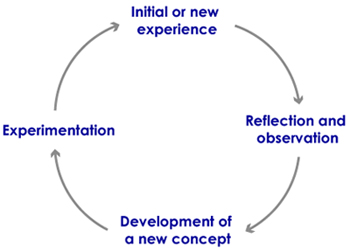
Action – Reflection – Action is a reflection model used in education and leadership. This model describes the process of learning, starting with taking an action. The process is cyclical because as action leads to reflection, a new action develops, and the process repeats.

While Elaine Graham and the National Association of Catholic Chaplains expand on the single step of reflection, and develop criteria for questions and sources to include in reflection, the action-reflection model shows the entire scope of the learning process. See this diagram from the Monash University’s Language and Learning Center, showing the continuous cycle of action and reflection.

action reflection action


Action and Contemplation is also a significant part of the Christian mystical tradition. There has long been a tension between works and acts and prayer and reflection. Richard Rohr’s Center for Action and Contemplation is a modern center for exploring the Christian tradition of contemplation. While contemplation unites lived experiences with stories of faith, it does not necessarily link them within culture and context. Read Richard Rohr’s definition here. Of course, culture and context infiltrate contemplation even if it is not a conscious choice. Therefore, perhaps it would be helpful to openly acknowledge the ways culture and circumstances impact contemplation. This is an example of an implicit curriculum. While culture and context are obviously embedded in the practices of contemplation, they are not named outright.

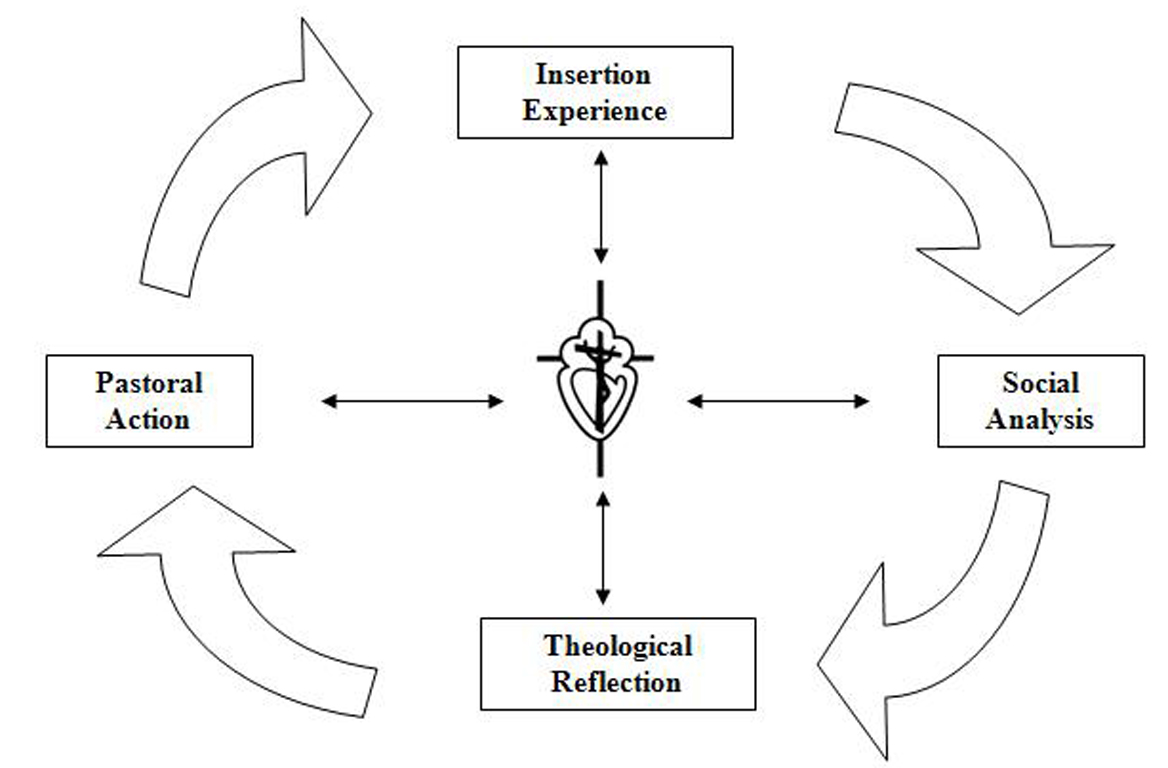
Joe Holland and Peter Henriot, S.J. advocate for taking stock of culture in their book Social Analysis: Linking Faith and Justice. They advocate for an extra step called social analysis and call their model the Pastoral Circle. It comprises an “insertion” experience, social analysis, theological reflection, pastoral planning. The following diagram comes from the blog Locus Theologicus (this post also contains an interesting discussion of Karl Rahner’s ideas about practical theology).

circle2

Holland and Henriot’s pastoral circle

Holland and Henriot list the following as factors in social analysis: historical dimensions, structural dimensions, divisions of society, and levels of reality. See a summary of the Pastoral Circle here.

 In Holland and Henriot’s work, I found three questions very helpful in adding social analysis to any circle of reflection. It could easily be added to contemplation as well as the action-reflection model. In considering divisions in society, they suggest asking these three questions:

Who makes the decisions?

Who benefits from the decisions?

Who bears the cost of the decisions?

In considering these factors, Holland and Henriot unite tradition, culture, and personal experience in a meaningful process of theological reflection.

Theological Reflection: Three Models

Theological reflection was first pioneered by Evelyn and James Whitehead in their book Method in Ministry. They proposed the practice of theological reflection to provide a way for seminary students to relate their experiences in field work to their theological studies in the classroom.

The National Association of Catholic Chaplains (NACC) posts a resource on their site for chaplains to learn more about theological reflection. You can view the power point slides here by clicking on the first option: “This is what theological reflection seeks to do…” This model, derived from the Whitehead’s theories, overlays culture/context, tradition, and experience to find meaning and theological relevance in everyday experiences.

I find these three overlapping categories helpful as I explore more models of theological reflection. I found that some models of theological reflection combine tradition and culture/context into one – or even exclude culture and context. Thus, the root version of theological reflection is: putting everyday experiences into conversation with religious tradition.

One of NACC’s slides defines theological reflection as serving “both to interpret life’s experiences in light of God’s purposes in Jesus, and to understand the Christian story about God in the light of what we are experiencing day-to-day.” This quote comes from Richard Gula’s Ethics in Pastoral Ministry. Again, this conversation between lived experience and the Christian story and traditions is the foundation of theological reflection.

Elaine Graham puts a spin on these categories in what she calls a “critical theology of pastoral practice” (Graham, 1996, p. 172). By incorporating feminist and gender theory, she names what was missing from original articulations of pastoral theology. In a sense, women’s experiences was the null (or omitted) curriculum of theological reflection. In her theological reflection, she uses women’s experience, the faith tradition, and the community of faith as sources for practical theology (p.173). This triad is more communally focused, incorporating community experience instead of personal experience.

Thomas Groome also suggests a triad for reflective learning using the concepts of time: past, present, and future. The past concerns disciplines and traditions; the present concerns lived experience now; and the future is the hoped-for vision of a better world. Tradition, lived experience, and current context and culture once again intersect in reflection. Groome also emphasizes the ongoing nature of this model – the ongoingness of learning, of reflecting, of becoming (Groome, 1980, p. 5-17).

Preach the Gospel at all times, when necessary, use words

When considering a helpful way of describing practical theology, I thought of the quote attributed to St. Francis of Assisi: Preach the Gospel at all times, when necessary, use words. When researching this phrase, I discovered that there is no record of St. Francis ever saying this and, in fact, Francis was a member of a preaching order. (Read about the myth here.)

This Christianity Today article argues for the importance of preaching the Gospel today. Of course, preaching is one of the original tasks of practical theology, along with teaching and pastoral care. Practical theology was assigned to the realm of ordained clergy, of which St. Francis was a member. Yet, while St. Francis was a member of a religious order and a preacher, he also challenged the status quo: eschewing wealth, placing value on the natural world and creation, and cultivating a deep devotion to prayer and service.

In this regard, perhaps St. Francis is a wonderful model for a practical theologian. St. Francis did not ignore what was going on in his world in order to preach a timeless word from the Gospel. His preaching combined the everyday realities of his world with the Gospel message.

When I started researching practical theology, I thought that practical theology concerned mainly everyday, non-verbal practices from which theological meaning could be extrapolated. I ignored the question: with what tradition should these everyday experiences be in conversation? It is hard to pull theological meaning out of a magician’s hat, so to speak. There must be theological traditions and cultural contexts – which, in the process, may themselves alter. But it is important to start somewhere. This is the antidote to relativism. Yes, many truths may exist, but where do you stand now?

Osmer on Theological Reflection

In Richard Osmer’s book Practical Theology: An Introduction, he outlines a four-fold model of theological reflection. Osmer’s aim is primarily to equip congregational leaders in theological interpretation in ministry. Osmer’s four tasks are:

  1. The descriptive-empirical task asks, ‘What is going on?’ – gathering information
  2. The interpretive task asks, ‘Why is it going on?’ – drawing on theories in arts and sciences to understand patterns and dynamics
  3. The normative task asks, ‘What ought to be going on?’ – using theological concepts to find ethical norms to guide responses
  4. The pragmatic task asks, ‘How might we respond? – determine strategies for action for a desirable outcome

This model is designed for practitioners to use in pastoral care situations. The big question raised in this model is: what norms and theories, both in arts and sciences as well as from theology, should one use? Osmer’s questions are situated in the Christian tradition but could be applied to other faith traditions.

You can see some diagram’s of Osmer’s model, as well as as summary of the book here.

Definition and History

I came across this helpful working definition of Practical Theology:

Practical theology is theological reflection that is grounded in the life of the church, society, and the individual and that both critically recovers the theology of the past and constructively develops theology for the future.
– Tony Jones on Theoblogy

It can be argued that, based on this definition, practical theology has always existed, in so far as human have asked questions about meaning and their lives. Yet, the academic and theological discipline of practical theology has a more specific, modern history. Practical theology developed to codify some of the ways Christians approach the task of meaning-making in their lives.

The discipline of practical theology developed with the rise of the scientific model and the modern university in the late 1700s and early 1800s in Europe (Osmer, 231). Instead of simply transmitting knowledge, universities were now charged with developing new research and knowledge. In response, Friedrich Schleiermacher, among others, developed a Theological Encyclopdia, arguing that Theology was a worthy subject within the research university model. In doing so, he argued for dividing theology into three fields: philosophical theology, historical theology, and practical theology. While the first two areas were promoted as areas of research and scholarship, practical theology was relegated to the work of ordained clergy and congregations. Since Schleiermacher’s early division, academic theology has evolved into four or more areas.

For the past 100 years, practical theology has largely been synonymous with pastoral theology, that is the preaching, teaching, and pastoral care of individuals and congregations (Osmer,  p.221). In many ways, practical theology became the application of the theories and ideas of the other branches of theology. Thus, practical theology is also known as applied theology. Reflection on tradition, culture, and individual and communal experiences remains at the heart of practical theology.

In the rest of my blog posts, I will explore different models and definitions of theological reflection and how practical theology is emerging as a field that bridges theological disciplines, but also offers unique insights into how theology and practice are relevant and evolving.