
Cynthia met Falk while Falk was an international student, doing some of his PhD research at UC Berkeley. While Cynthia had lived in Germany when she was younger, their families came from different cultures and spoke different languages.
Below is my summary of some of the traditions and personal values they brought to their wedding and how they were reflected in the wedding ceremony.
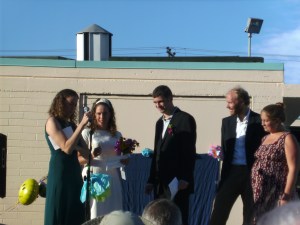
Cynthia and Falk prepare to read their vows
Tradition: Falk grew up in the DDR and religion was not a part of his upbringing, Cynthia’s family was only nominally religious. Yet, family and community as well as connecting across ethnic and cultural borders were important to both families.
Personal Story/Values: they met while traveling to Yosemite; they both love to bike and eschew car ownership; and they believe in gender equality.
These values and traditions were reflected in the ceremony in the following ways:
Fun and Family: Falk and Cynthia chose a fun venue, a local swimming pool, to get married at and the ceremony was preceded by a game of bally-ball (a version of water polo without rules). The teams were Germany vs. USA.
Community: All parts of the ceremony were read in both English and German. They chose to use the German model of having “witnesses.” Traditionally, these witnesses sign the marriage certificate but do not play the ornamental roles that bridesmaids and groomsmen play in the US.
Equality: They walked down the aisle (out of the locker room) together instead of being “given” away by parents, they read their own vows, and they rode away from the wedding on tandem bike, with Cynthia riding in front.
While Cynthia and Falk did not use models of theological reflection to prepare their wedding, they did ask questions about their personal stories and values as well as the history and traditions (largely cultural and familial) that were important to them.
 Katherine Kunz, Ph.D.