
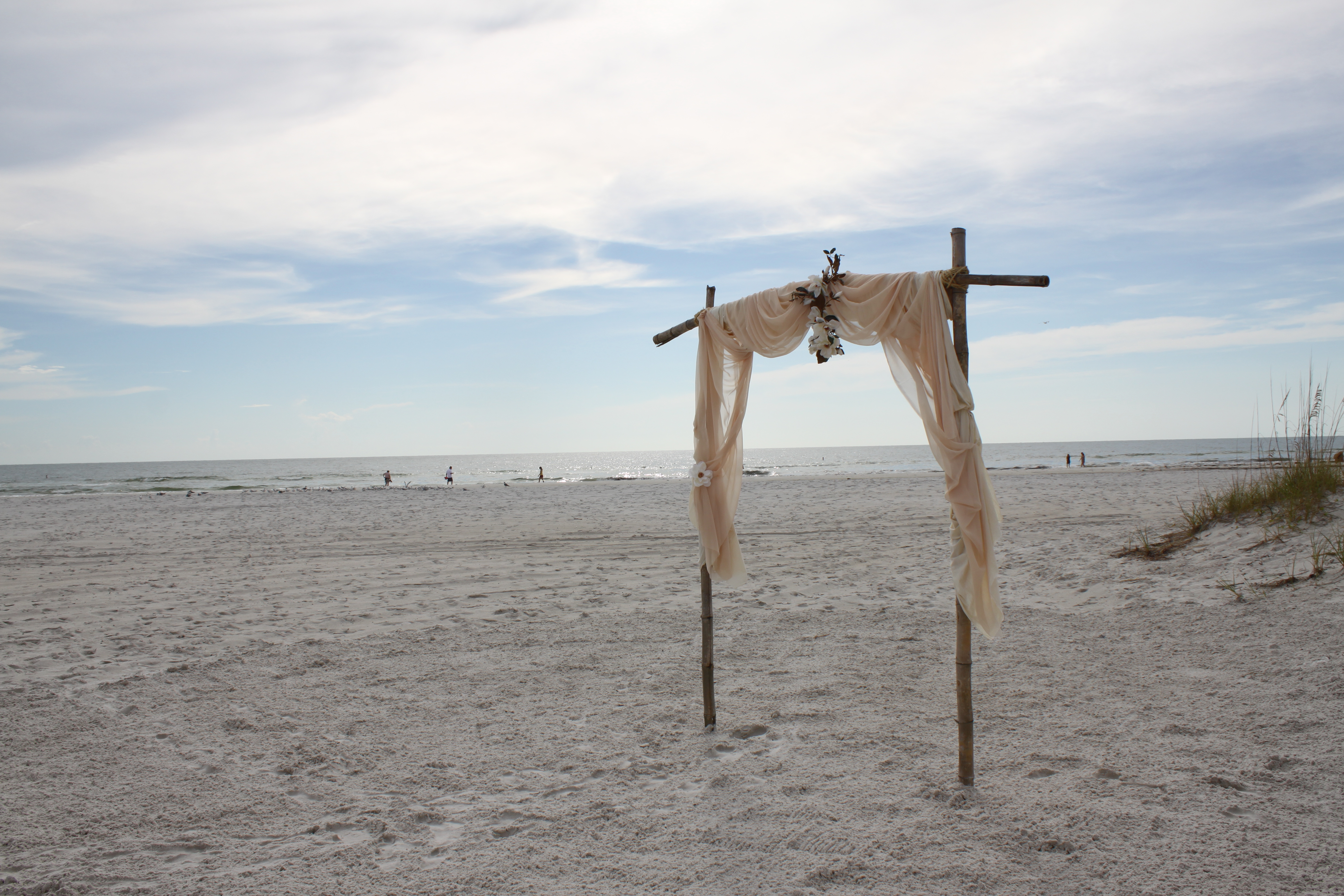
Anna and Chris, St. Pete, FL 2012
Life cycle rituals
I often officiate weddings for friends. Marriage is an institution that has undergone radical change in the last decade. Once an institution devoted to economic and social stability, marriage has evolved, in the West, to an institution based on notions of love. This is one reason I chose weddings as a case study: how do modern couples make sense of a ritual that developed partly for economic and social reasons that are no longer relevant? In addition, many of the friends whose weddings I officiate do not identify with a specific religious tradition. They often identity as spiritual but not religious, interfaith, non-religious, or questioning. So even the religious basis of marriage is often missing from these ceremonies.
Yet, a wedding ceremony and a marriage commitment are life events that prompt reflection. It could be argued that there are few things in life that ask for a commitment like marriage. What are ways that a couple who does not identify with one religious tradition engages in reflection on marriage? Of course, the wedding ritual is one moment in the life of two individuals. The cyclical models of reflection I discussed are relevant to the duration of a marriage, or relationship.
I do not usually engage in pre-marital counseling for couples I marry, but I do ask three questions that help me (and, hopefully, the couple) reflect on their commitment.
1) How did you meet?
2) What is a favorite memory or quality of the other person that you value?
3) Why do you want to get married?
The first question helps me to e a piece of their story – a story that they share and a story that is often told or reflected upon in the wedding ceremony. In this age when it is increasingly common for couples to have met online, the first question often prompts stories of their first date, of meeting one another’s families, or how they got engaged. The point is that this question evokes a particular story that the couple shares and is significant to their path to marriage.
The second question asks each individual to reflect on the other person, apart from their shared history. Again, adding a piece of the story through the eyes of the other.
The third question asks the couple to reflect on their reasons for choosing to get married: are they cultural, religious, spiritual, convenience, or romance? This question hopes to elicit what roles and reasons tradition, culture, and personal beliefs play in the couple’s desire to marry.
These questions fit into the model of theological reflection by creating dialogue between personal stories, communal experiences, and tradition. Thus, in looking at two specific case studies, I will use this model of theological reflection, knowing the Christian story does not feature exclusively into these ceremonies.
 Katherine Kunz, Ph.D.